Christopher J. Patrick
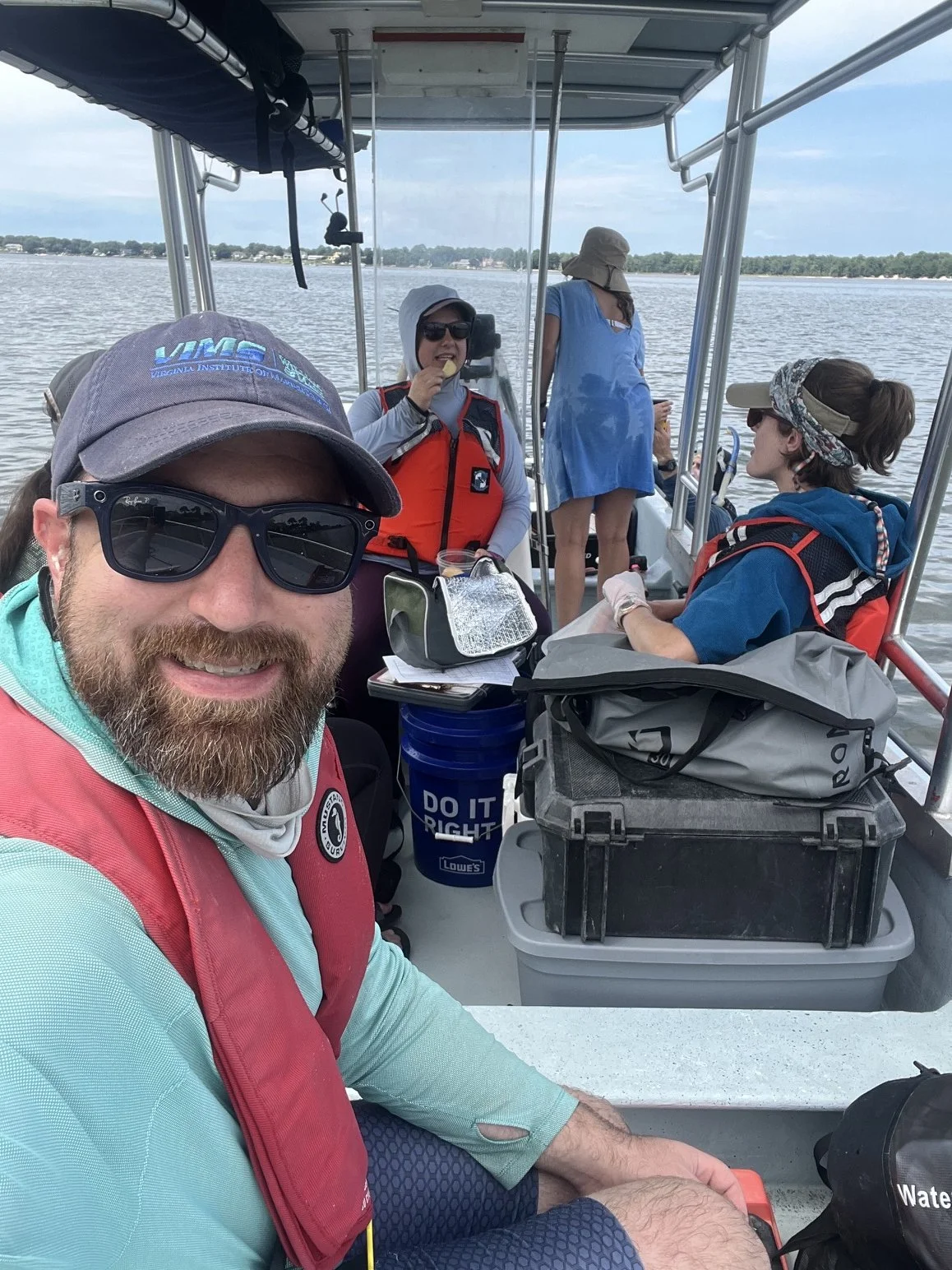
Current Job: Director of the SAV Monitoring & Restoration Program at VIMS (Virginia Institute of Marine Science)
Current Project: My group is currently working on a suite of different projects! Some of our ongoing work includes inventorying all of the seagrasses and SAV through the tidal waters of Maryland and Virginia and assessing the structure and function of seagrass meadows in Virginia's coastal lagoons. Two of our current grant funded projects involve a large scale effort to restore eelgrass to Burton's Bay on Virginia's seaside and an effort to quantify the contributions that widgeon grass meadows restored near Virginia Beach make to secondary production and resource provisioning. We are also continuing to push forward with new research initiatives led by students and post-docs on diverse topics ranging from microbial probiotics for restoration to the functional role of stingrays in seagrass meadow ecology.
State(s) working in: Virginia, D.C., Maryland
Where are you from: Annapolis, Maryland
What do you think is the main reason we should protect SAV?
I personally think we have a duty to protect SAV because its part of our responsibility to be good stewards of our natural resources. But if you want to get practical, the enormous value of the ecosystems services it provides, particularly its ability to improve water clarity and significantly enhance fisheries and crab production, are also excellent reasons. It is in our best interest to protect this foundation habitat.
How do you feel your research will make a difference in the SAV community?
I think my biggest impact today is providing positive messages to the SAV research community, particularly to those individuals working on restoration and conservation of SAV. Our program's restoration success stories and the incredible natural recoveries of SAV we are now documenting in the lower Chesapeake Bay really showcase just how resilient SAV can be, which can be uplifting if your research system in currently in decline. Furthermore, the decades of troubleshooting that VIMS has undergone to build our restoration and monitoring knowledge base provides a blueprint for success that we are sharing with anyone who is interested!
What is one of your best memories working with SAV?
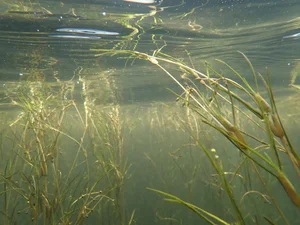
A few years ago my team and I were cutting across a sand flat racing the falling tide and we got stuck. We raised the engine and started walking the boat through the shallows when we stumbled onto a beautiful patch of eelgrass that we had planted two years prior but had assumed had not survived due to low seedling establishment numbers. The water there was normally turbid, but on this day it was crystal clear and we could see every plant. It was such a wonderful surprise to find the grass there and every leaf looked so vibrant and healthy. We spent 45 minutes wandering around taking pictures and exploring the extent of the grass. It was the first eelgrass that had been in that area in 90 years and it was just such an amazing feeling to be responsible for its return.
What keeps you motivated to keep caring about the future of SAV?
I care about the future of SAV because it is functionally important but nostalgia is at work as well. As a kid on Cape Cod I remember stalking the eelgrass meadows at low tide for interesting creatures and I love sharing those experiences with my kids today. I want the grass to be there for my future grand children and the generations that come after.
More about Christopher’s story
I grew up splitting my time between the Chesapeake Bay and Cape Cod and developed a deep love of the water at a young age. I think I always knew what I wanted to be, a marine biologist, but it took a while for me to work my way there. I received a B.S. in Biology from the University of Maryland, College Park (2002-2006) where I began my research career working in freshwater streams. I then traveled inland to the Midwest where I pursued a Ph.D. at The University of Notre Dame (2006-2011), focusing on the relationship between biodiversity and ecosystem function across spatial scales in river networks. After graduating I returned to Maryland as a Research Scientist at the Smithsonian Environmental Research Center in Edgewater, Maryland (2011-2014) and I began working on Chesapeake Bay SAV. I followed this with a stint as a AAAS S&T Policy Fellow placed with EPA Office of Science & Technology (2014-2015) before moving south to join the faculty of Texas A&M University, Corpus Christi where I worked in Halodule and Thalassia meadows (2015-2020). I loved my time on the Gulf of Mexico, but was thrilled at the opportunity to return to my Mid-Atlantic roots and take over the Directorship of the VIMS SAV Monitoring & Restoration Program in 2020. In my role here at VIMS I work to ensure that we continue to provide the scientific community with the highest quality SAV data for Maryland and Virginia tidal waters and lead a wide array of research, restoration, and mitigation projects for local, state, and federal programs.