Current Job: Graduate Research Assistant, University of Maryland Eastern Shore
Current Project: Increasing eelgrass' thermal resilience at Assateague Island National Seashore, analyzing the role of seascape connectivity in blue carbon sequestration
State(s) working in: Maryland
Where are you from: New York, NY
What do you think is the main reason we should protect SAV?
SAV provides countless ecosystem services, but I think eelgrass' importance as a foundation species for critical nursery habitat can't be overstated.
How do you feel your research will make a difference in the SAV community?
My research ultimately aims to help eelgrass meadows adapt to heat stress. We're taking an innovative approach to restoration, using seeds sourced from North Carolina, Maryland, and New York to assess which populations perform best in Maryland. The ultimate goal is to confer the thermal resilience of warm-adapted populations to our local populations (via assisted gene flow), potentially increasing the longevity of these threatened meadows. We're also testing new planting methods, including burying clay "seed balls," which will inform future restoration projects.
What is one of your best memories working with SAV?
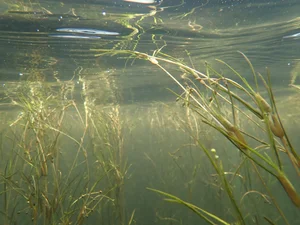
It's always a blast to bring my lab group out on the water to harvest reproductive shoots for restoration from Chincoteague Bay's eelgrass meadows. Teaching my peers about eelgrass and watching them get excited about tiny seeds is such a joy and a great reminder of why I love working with SAV.
What keeps you motivated to keep caring about the future of SAV?
Witnessing the natural beauty and biodiversity in eelgrass meadows always leaves me inspired to keep working towards protecting and restoring these vital ecosystems.
More about Katie’s story
I was born and raised in New York City and grew up spending a lot of time on Long Island, where I fell in love with salt marshes. I earned my BA in Environmental Studies from Hamilton College in Clinton, New York, where my undergraduate research focused on modeling the impacts of sea level rise on salt marsh carbon sequestration. From there, my interest in blue carbon took off and led me to the world of seagrass!
In my graduate studies at the University of Maryland Eastern Shore, I manage a pilot-scale eelgrass restoration study at Assateague Island National Seashore. Collaborating with several institutions along the east coast, we're in the process of running a common garden experiment to analyze how eelgrass seeds sourced from varying temperature regimes (North Carolina to New York) perform under local conditions in Chincoteague Bay. For my master's thesis, I'm also examining the effect of seascape connectivity on blue carbon sequestration through a meta-analysis.